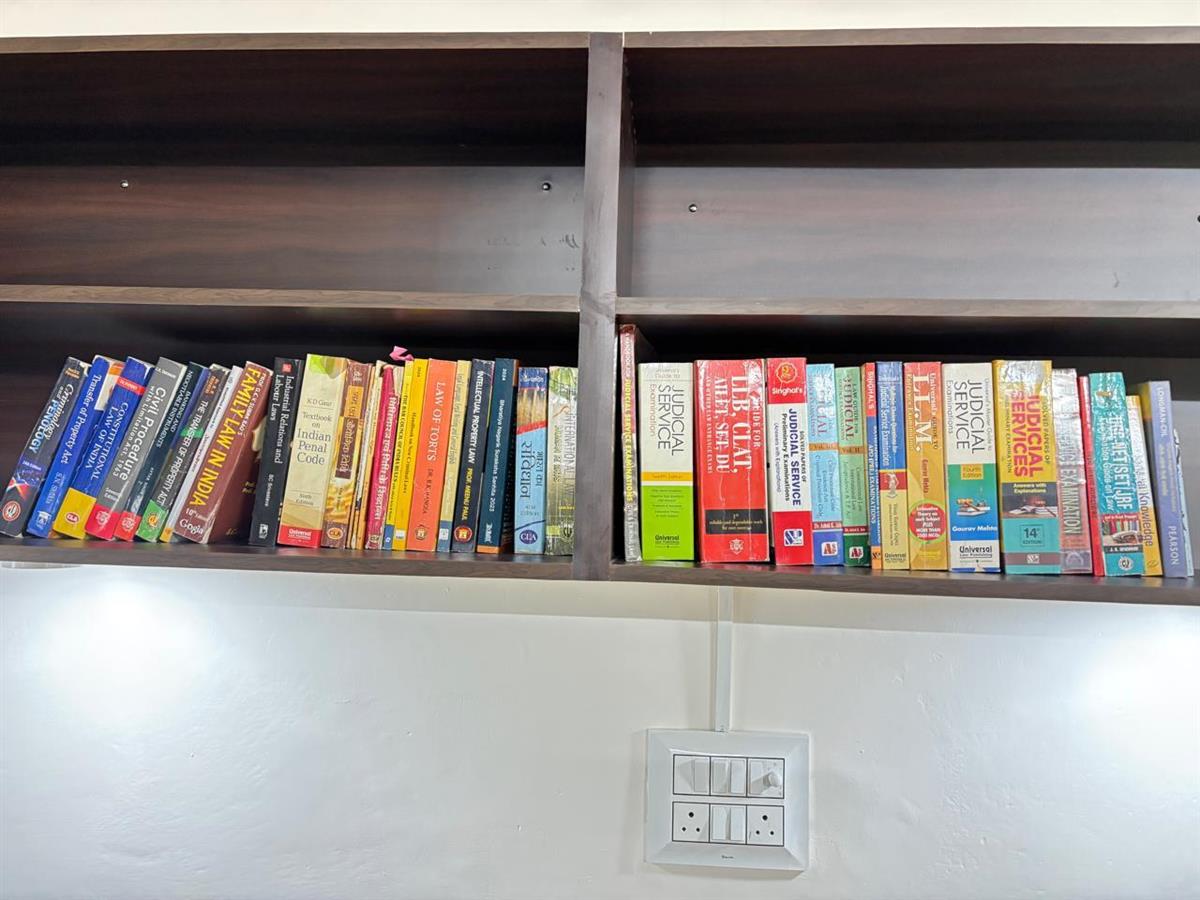
The racks shown at the top of this post are the CLAT, Judiciary and entrance-exam shelf at the centre — the titles the batch works from, not a stock image.
The weightage tells you where the paper is decided
| Section | Questions | Weight | What it rewards |
|---|---|---|---|
| English Language | 22–26 | 20% | Reading accuracy, grammar under pressure |
| Current Affairs incl. GK | 28–32 | 25% | Recall of what happened in the last twelve months |
| Legal Reasoning | 28–32 | 25% | Principle applied to the facts in front of you — not the principle you memorised |
| Logical Reasoning | 22–26 | 20% | Sequences, syllogisms, arrangements, inference |
| Quantitative Techniques | 10–14 | 10% | Speed on elementary maths — ratio, algebra, mensuration, estimation |
Weightage shown is the pattern applied for the 2026 cycle as summarised by exam pages such as PW’s CLAT pattern page. The authoritative version is the pattern the Consortium notifies for the attempt you are writing — check it before you plan against these numbers.
“If your answer comes from outside the passage, it is probably wrong — even when the law you remember is correct.”
Section by section, the way we train it
- Legal reasoning: work from the stated principle, then apply it to the facts given. Most lost marks come from answering with the general rule instead of the rule the passage hands you. Train this as a method, not as a syllabus.
- Comprehension and English: 450-word passages, Class 12 level. Practise inference and tone, not just vocabulary. A clean first read saves two re-reads.
- Current affairs and GK: the habit beats the cram. Ten minutes a day, in a dated note, and a weekly brief that pulls last month back into view. By February the notes are the revision.
- Logical reasoning: sets, arrangements, blood relations, analogies — the marks are quick if you read the question once carefully.
- Quantitative techniques: lowest weight, fastest marks. Do not abandon it; elementary maths at 10% is 12 questions you can usually finish inside twenty minutes.
Negative marking changes how you attempt
Unlike AIBE, CLAT charges for a wrong answer. So the skill is not only knowing — it is deciding. Narrow the options first. If you cannot eliminate two, leave it and come back. A skipped question costs nothing; a guessed one costs a quarter mark that you cannot recover with a later correct answer.
Set a target per section before the mock, then compare it with what you actually spent. Timing is trained by measurement, not by intention.
CLAT PG, briefly
PG papers stay comprehension-driven, on longer passages from legal writing, with legal awareness covering concordance and legal maxims, and a short essay or answer-writing component. Because the weightage and the essay treatment differ cycle to cycle, the plan below should be checked against the notification for the attempt you are writing before you rely on it.
A week in the CLAT batch
Monday–Friday
Daily note + 10 questions
Dated, cumulative, one subject in focus. Older sections come back into play each week.
Saturday
Full paper, timed
Two hours, real conditions, no phone, no second reading.
Sunday
Analysis, not score
Line-by-line on what you got wrong, and why the wrong option looked tempting.
Fee and mode
CLAT preparation is ₹24,000 per year, payable in quarterly instalments, and the track runs online or offline at the Ganga Nagar centre — smart-board classrooms, AC, high-speed Wi-Fi, and the legal library for reference. Judiciary is on the same fee structure, and AIBE is a separate four-month course at ₹3,000.
₹24,000 per year · quarterly instalments · online or offline — fee & FAQ
Sources used for the pattern facts
Official: Consortium of National Law Universities. Section-wise weightage cross-checked against PW’s CLAT 2026 pattern page. The numbers change with each notification, so match this post to the current cycle before it is quoted anywhere.
Enquiry — this post